
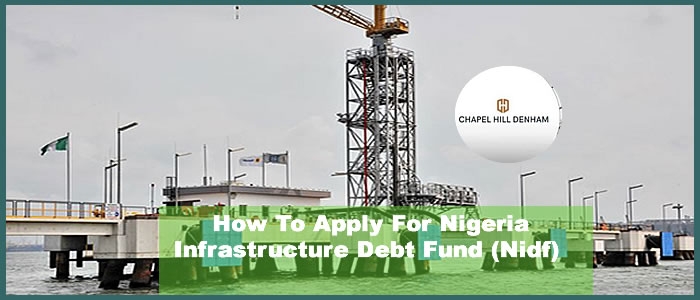
The Nigeria Infrastructure Debt Fund | NIDF is an infrastructure-focused investment fund that provides long-term, naira-denominated debt financing to infrastructure projects and businesses in Nigeria. This guide explains how to apply for Nigeria Infrastructure Debt Fund (NIDF) financing, who qualifies for NIDF funding in Nigeria, the main NIDF eligibility requirements, how to invest in NIDF and how to buy NIDF units. Unlike a conventional government grant programme, NIDF is a regulated, closed-ended investment fund whose units are listed on the Nigerian Exchange (NGX) and FMDQ.
This distinction is important because people searching online for NIDF funding, NIDF application, or Nigeria Infrastructure Debt Fund application may assume that NIDF is a government scheme where individuals or SMEs simply complete an online form and receive free money.
That is not how the fund operates.
NIDF is designed to mobilise investment capital and use it to provide debt financing for commercially viable infrastructure projects. Its investment portfolio has included areas such as pipeline infrastructure, marine infrastructure, off-grid solar, telecommunications towers, broadband, gas processing, independent power projects and student accommodation.
As of 26 September 2026, current evidence confirms that NIDF is an operating investment fund. Its official website was displaying a current unit price of ?147.70 on 23 September 2026, while its latest available 2026 financial announcement reported continued infrastructure lending and a second-quarter distribution.
This guide explains what NIDF is, who may interact with it, how its financing model works, what benefits it can provide, how investors can access the fund, and how to distinguish genuine NIDF information from misleading funding advertisements.
Whether a reader searches for Nigeria Infrastructure Debt Fund, NIDF Nigeria, NIDF fund or Nigeria Infrastructure Debt Fund NIDF, the subject is the same regulated vehicle. References to NIDF investment, NIDF investment in Nigeria and a Nigeria infrastructure investment fund should therefore be understood in the context of a listed fund that channels capital into infrastructure debt, not a retail grant programme.
What Is the Nigeria Infrastructure Debt Fund?
The Nigeria Infrastructure Debt Fund, commonly abbreviated as NIDF, is a Nigerian infrastructure debt investment fund managed by Chapel Hill Denham Management.
NIDF was established in 2017 and commenced operations on 28 June 2017. Its units were initially listed on the FMDQ OTC Exchange and were subsequently listed on the Nigerian Exchange in October 2023. The fund is registered and regulated by the Securities and Exchange Commission (SEC), Nigeria.
The fund's basic model is relatively straightforward:
Investors provide capital → NIDF invests in infrastructure debt → infrastructure borrowers repay the debt → NIDF generates income → eligible unitholders receive distributions, subject to the fund's performance and governing documents.
NIDF describes its objective as providing investors with regular, sustained, long-term distributions and exposure to naira-denominated infrastructure debt.
The fund is therefore different from a government grant.
Grant vs loan vs debt fund
A grant is money provided for an approved purpose that generally does not have to be repaid, subject to the terms of the programme.
A loan is borrowed money that must normally be repaid, usually with interest or another financing cost.
Debt financing is funding provided to a borrower under contractual repayment terms. The borrower is expected to repay the principal and applicable financing costs.
Equity investment involves providing capital in exchange for an ownership interest.
A fund pools or manages capital according to a defined investment strategy. Investors in NIDF own units in the fund; NIDF uses its capital to make infrastructure debt investments.
Therefore, NIDF should not be described as a source of free government money.
Why Was NIDF Created?
Infrastructure projects often require large amounts of capital and may generate cash flows over many years. Short-term financing can therefore create a mismatch between the period over which a project earns revenue and the period over which its debt must be repaid.
NIDF was created to help address this financing challenge by providing long-term, local-currency infrastructure debt.
The fund's 2025 impact report explains that its purpose is to channel long-term institutional capital into naira-denominated infrastructure debt so that projects can obtain financing that better matches their economic lives and revenue profiles.
This model is relevant because infrastructure projects can involve substantial capital expenditure and lengthy development and repayment periods.
NIDF's portfolio has included infrastructure connected to:
- Energy and power
- Pipeline networks
- Telecommunications
- Broadband
- Solar infrastructure
- Marine infrastructure
- Gas processing
- Independent power projects
- Student accommodation
The exact portfolio changes over time as loans mature, are repaid, or new investments are added.
As at 31 December 2025, the fund reported 20 infrastructure investments across nine sub-sectors.
Who Qualifies for NIDF Funding in Nigeria? Eligibility Requirements
This question needs to be separated into two different groups: investors and infrastructure borrowers.
1. Investors
NIDF is a listed investment vehicle. Its units trade on the Nigerian Exchange, meaning investors can gain exposure to the fund through the capital market rather than applying for a conventional government grant.
The fund's 2025 report identifies its ticker as NIDF, with listings on NGX and FMDQ.
Because the units are publicly listed, investors should use an appropriate regulated investment or stockbroking channel and comply with the applicable account-opening and KYC requirements of that intermediary.
The exact minimum amount, charges and trading procedures can vary according to the intermediary and market conditions. Investors should therefore confirm current requirements before placing an order.
For people researching an NIDF investment opportunity, NIDF investors, who can invest in NIDF, how to invest in NIDF or how to buy NIDF units, the practical route is through a regulated stockbroker or other authorised market intermediary. Searches for NIDF units price, NIDF share price, NIDF NGX, NIDF stock price Nigeria or NIDF NGX price today all concern the market price of listed fund units—not ordinary company shares—and the live price should be checked through NGX, the fund or an authorised broker before trading.
2. Infrastructure project sponsors and businesses
NIDF's other important group is infrastructure project sponsors and businesses seeking debt financing.
The fund's 2025 Fund Manager's Report states that NIDF seeks to build a diversified portfolio of loans to projects or businesses that:
- Provide essential economic or social services;
- Have predictable cash flows; and
- Utilise assets with long useful lives.
This means that a normal individual looking for personal business capital should not automatically assume that NIDF is an SME loan programme.
The fund is focused on infrastructure debt and commercially viable projects.
Potential project characteristics therefore need to be assessed against the fund's investment strategy rather than simply against a generic "business funding" checklist.
Who Does Not Qualify?
There is no evidence that NIDF is designed as a universal funding programme for every Nigerian citizen or small business.
In particular, readers should not assume that they qualify simply because they:
- Have a registered business;
- Have a business idea;
- Need working capital;
- Are unemployed;
- Want a personal loan;
- Want a government grant; or
- See an online advertisement claiming that NIDF applications are open.
NIDF's documented investment strategy is centred on infrastructure debt and commercially viable infrastructure projects.
A project that does not fit the fund's infrastructure financing strategy may therefore not be suitable, regardless of whether the business is legally registered.
Where a specific financing opportunity is being considered, the fund manager or authorised financial intermediary would need to assess the project under the applicable investment and credit requirements.
NIDF Funding for Infrastructure Projects: How the Financing Works
NIDF operates primarily as a debt-financing vehicle.
Instead of giving an infrastructure project an outright grant, the fund invests capital through infrastructure loans.
The fund's 2025 report showed that its infrastructure loan portfolio had a weighted average annualised yield of 19.87%, with a weighted average tenor at disbursement of 9.61 years and a weighted average remaining life of 7.35 years at 31 December 2025.
The report also showed that 96% of the loan portfolio was senior secured and 95% was floating rate at that date.
These figures describe the portfolio and should not be interpreted as a guaranteed return for investors or a guaranteed interest rate for every borrower.
The loans are generally structured around the characteristics of the underlying infrastructure projects, including their cash flows and assets.
The 2025 portfolio included 100% naira loans, reflecting the fund's focus on local-currency infrastructure financing.
In this sense, NIDF financing, NIDF infrastructure financing, NIDF infrastructure fund and the commonly used phrase NIDF loan in Nigeria all point to the same specialist role: providing long-term infrastructure financing in Nigeria. NIDF is one participant in the broader markets for infrastructure debt fund Nigeria, infrastructure financing in Nigeria, long term infrastructure financing Nigeria and Nigerian infrastructure investment.
How Much Funding Is Available?
This is one area where caution is essential.
NIDF has a substantial capital base, but the fund's total assets or capital base should not automatically be described as money currently available for any applicant to borrow.
For example, as at 31 December 2025, NIDF reported net assets of approximately ?130.74 billion, while its infrastructure loan portfolio was approximately ?97.25 billion.
By June 2026, NIDF reported a capital base of more than ?130.5 billion and an infrastructure loan portfolio covering 17 loans across seven sub-sectors.
These figures demonstrate the scale of the fund but do not establish that an equivalent amount is available for new applicants.
Funding decisions depend on the fund's investment strategy, available capital, project quality, due diligence, approvals, documentation and other applicable conditions.
Nigeria Infrastructure Debt Fund Benefits and Investment Returns
The benefits should be divided into financing benefits for infrastructure projects and investment benefits for unitholders.
Potential benefits for infrastructure projects
For qualifying projects, the NIDF model can provide:
- Long-term naira-denominated debt;
- Financing matched more closely to project cash flows;
- Access to infrastructure-focused investment capital;
- Financing for commercially viable infrastructure assets;
- Potentially longer financing tenors than some conventional financing arrangements.
The fund's stated objective is to provide long-term financing to infrastructure projects in Nigeria.
The range of NIDF infrastructure projects also helps explain the fund’s place in NIDF infrastructure investment and wider NIDF Nigeria investment opportunities. For sponsors, the potential NIDF benefits include debt tenors and local-currency structures suited to qualifying assets; for unitholders researching the benefits of investing in NIDF, potential income and diversified infrastructure exposure must be weighed against credit, liquidity, interest-rate and market risks.
Potential benefits for investors
For investors, NIDF provides exposure to infrastructure debt through a listed investment vehicle.
NIDF reported that it had made quarterly distributions throughout its operating history, while stressing that distributions depend on actual performance and the fund's governing documents.
For example, NIDF announced a ?4.40 per-unit distribution for Q2 2026. The announcement dated 6 July 2026 said the distribution represented the fund's 37th distribution since inception.
Readers often use NIDF dividend or NIDF dividend payment when referring to these cash distributions, although “distribution” is the more precise term for a fund. Any NIDF quarterly distribution contributes to realised income, while broader NIDF returns or NIDF investment returns may also reflect changes in unit value; neither future distributions nor total returns are guaranteed.
However, investors should remember that past distributions and past performance do not guarantee future results. NIDF's own risk warning states that investment value and income can rise or fall and that investors may lose some or all of their initial investment.
How to Apply for Nigeria Infrastructure Debt Fund: NIDF Funding Application Process
This is where many online articles can become misleading.
NIDF is not currently presented as a general public government grant application portal.
There is no evidence, as of 26 September 2026, of a current official public application window where every Nigerian can submit a form for free NIDF funding.
Accordingly, searches such as NIDF how to apply, NIDF application process, NIDF funding application, NIDF loan application and NIDF application 2026 should not be interpreted as evidence of a universal online form. For a project sponsor, the relevant NIDF eligibility, NIDF eligibility requirements and question of who qualifies for NIDF depend on infrastructure fit, commercial viability, predictable cash flow, due diligence and the fund manager’s approval process.
Instead, NIDF operates as an investment fund and infrastructure debt provider.
How to Invest in NIDF and Buy NIDF Units
Investors seeking NIDF units should use an appropriate regulated market intermediary and verify the current trading and account-opening requirements.
NIDF's official website provides information about the fund and its investment structure.
If you are an infrastructure project sponsor
A project sponsor seeking infrastructure debt should first establish that the project fits the fund's investment strategy.
A sensible process is:
Step 1: Understand the investment strategy
Determine whether the project provides essential economic or social services and whether it has predictable cash flows and suitable underlying assets.
Step 2: Prepare the project information
A serious infrastructure financing proposal should be capable of explaining:
- The project
- Ownership structure
- Business model
- Revenue model
- Project costs
- Existing financing
- Expected cash flows
- Regulatory position
- Key risks
- Proposed financing requirement
Step 3: Verify regulatory requirements
Infrastructure projects may require sector-specific approvals, licences, permits and environmental or other regulatory documentation.
Step 4: Contact the fund through an official channel
NIDF's official contact page identifies its Lagos office and official contact details.
Readers should independently verify contact details before submitting confidential documents.
Step 5: Undergo assessment
A project seeking debt financing would be expected to undergo commercial, financial, legal and other relevant due diligence.
Step 6: Financing decision
Approval is not automatic. Any financing would depend on the fund's assessment, investment mandate, documentation and applicable approval processes.
What Documents Might Be Required?
There is no single current public NIDF application checklist that should be presented as applying to every infrastructure project.
Depending on the financing structure and project, applicants may be asked to provide information such as:
- Corporate registration documents
- Ownership information
- Financial statements
- Project proposal
- Business plan
- Financial model
- Project budget
- Cash-flow projections
- Regulatory approvals
- Existing financing information
- Asset information
- Relevant environmental and social documentation
- Evidence supporting project revenues
- Security or collateral documentation where applicable
These should be treated as potential categories rather than a confirmed universal NIDF checklist.
The actual requirements should be confirmed directly with the authorised fund manager or relevant transaction team.
NIDF Compared With Other Funding Options
|
Financing type |
Basic structure |
Usually repaid? |
Main purpose |
|
Government grant |
Financial support for an approved purpose |
Generally no, subject to conditions |
Specific development or social objectives |
|
Commercial bank loan |
Borrowed money from a bank |
Yes |
Business or project financing |
|
Development-finance loan |
Financing from a development-focused institution |
Usually yes |
Development and economic projects |
|
Equity investment |
Capital exchanged for ownership |
Not normally repaid like a loan |
Business/project growth |
|
NIDF |
Infrastructure-focused debt investment fund |
Project borrower repays debt |
Long-term infrastructure financing |
The important point is that NIDF is a debt-investment structure, not a general grant scheme.
Is NIDF Still Active in Nigeria? Nigeria Infrastructure Debt Fund 2026 Update
Current status verified: 26 September 2026
Yes. Current evidence confirms that the Nigeria Infrastructure Debt Fund is active as an operating investment fund.
Several current indicators support this conclusion.
First, NIDF's official website was displaying a unit price of ?147.70 as at 23 September 2026, demonstrating current market activity.
Second, the fund published 2026 financial results through the Nigerian Exchange. Its 6 July 2026 announcement reported ?10.63 billion profit before tax for the first half of 2026, continued infrastructure lending and a ?4.40 per-unit Q2 distribution.
Third, the June 2026 announcement stated that NIDF's infrastructure loan portfolio contained 17 loans across seven sub-sectors and that the fund had a capital base exceeding ?130.5 billion.
People searching for NIDF latest news, an NIDF latest update, the NIDF current status or asking “Is NIDF still active?” should rely on dated official disclosures rather than reposted advertisements. For NIDF investment 2026 and Nigeria Infrastructure Debt Fund 2026 research, confirm the latest unit price, financial results, portfolio information and distribution notices directly through official fund, NGX and regulatory sources.
But is NIDF currently accepting general applications?
No current evidence was found of a general public NIDF funding application window for individuals or ordinary SMEs.
This distinction is critical.
NIDF is active, but that does not mean there is an open government-style application programme where Nigerians can apply online for free funding.
The evidence instead shows an operating investment fund that raises capital, invests in infrastructure debt and finances commercially viable infrastructure projects.
Therefore, an online advertisement saying "NIDF registration is now open—apply for ?50 million government funding" should be treated with caution unless the claim can be independently verified through official NIDF or relevant regulatory sources.
How to Verify an NIDF Opportunity
Before submitting documents or paying money, use this checklist.
Check the official website
Start with the official NIDF website:
Verify the administrator
NIDF identifies Chapel Hill Denham Management as its fund manager.
Check NGX disclosures
Financial results and market disclosures can also be checked through the Nigerian Exchange's official disclosure systems.
Be suspicious of WhatsApp-only applications
A WhatsApp message claiming that you have been selected for NIDF funding is not evidence of an official programme.
Do not pay unexplained fees
Be cautious if someone demands money for:
- Registration
- "Approval"
- "Activation"
- "Release of funds"
- "Government connection"
- "Processing" through an unofficial agent
Never share banking credentials
Never give an alleged funding agent your:
- ATM PIN
- Internet banking password
- OTP
- Card PIN
- Full authentication codes
A legitimate financing process should not require you to hand over confidential banking credentials.
Common Mistakes Applicants and Investors Should Avoid
1. Confusing NIDF with a grant
NIDF is an infrastructure debt fund, not a general free-money programme.
2. Using outdated information
An old article may describe a previous capital raise, minimum subscription, offer period or application procedure that no longer applies.
3. Trusting social-media adverts
A Facebook, TikTok, Instagram or WhatsApp post is not automatically an official government announcement.
4. Assuming approval is guaranteed
Infrastructure financing involves due diligence and investment decisions.
5. Assuming the entire fund's capital is available
The fund's reported assets or capital base should not be interpreted as an amount that every applicant can borrow.
6. Paying unofficial agents
Use official channels and independently verify any person claiming to represent NIDF.
7. Treating historical interest rates as current
Financing costs can change with market conditions and project risk.
8. Ignoring repayment obligations
Debt financing must be distinguished from grants. Borrowers should understand the financial obligations created by a financing agreement.
Hypothetical Example: How an Infrastructure Project Might Approach NIDF
This example is hypothetical and does not represent an actual NIDF application or guaranteed outcome.
Imagine a Nigerian company develops a commercially viable solar infrastructure project.
The company requires long-term naira financing to develop the project and expects the asset to generate predictable revenue over many years.
The company could begin by assessing:
Project concept: Solar infrastructure
Business structure: Registered project company
Funding requirement: Long-term infrastructure debt
Initial eligibility assessment: Does the project provide an essential service, have predictable cash flows and utilise long-life infrastructure assets?
Documentation: Corporate records, financial model, project information, regulatory approvals and other relevant documentation.
Due diligence: Financial, commercial, technical, legal and environmental assessments.
Financing decision: Subject to NIDF's investment mandate, available capital, due diligence and final approval.
The example demonstrates why infrastructure debt financing is fundamentally different from completing a simple grant application form.
Frequently Asked Questions About NIDF
1. What is NIDF?
NIDF stands for Nigeria Infrastructure Debt Fund. It is a regulated, listed infrastructure debt investment fund focused on long-term naira-denominated infrastructure financing in Nigeria.
How to apply for Nigeria Infrastructure Debt Fund (NIDF)?
There is no verified general public grant form. An infrastructure sponsor should determine whether the project fits NIDF’s mandate, prepare commercial and financial information, contact the fund through an official channel and undergo due diligence. Investors do not submit a funding application; they access listed units through a regulated market intermediary.
2. What does NIDF stand for?
NIDF means Nigeria Infrastructure Debt Fund.
3. Who manages NIDF?
NIDF is managed by Chapel Hill Denham Management.
4. Is NIDF a government grant?
No. NIDF is an infrastructure debt investment fund, not a general government grant programme.
5. Who qualifies for NIDF funding in Nigeria, and what are the NIDF eligibility requirements?
Potential infrastructure borrowers must fit the fund’s infrastructure-focused mandate and generally demonstrate a commercially viable project, essential economic or social services, predictable cash flows, suitable long-life assets and the ability to pass financial, legal, commercial and other due diligence. NIDF is not presented as a general personal-loan or individual grant programme.
6. Can SMEs apply?
An SME should not assume that it qualifies simply because it is an SME. The project or business would need to fit NIDF's infrastructure-focused investment strategy and satisfy the applicable assessment requirements.
7. How much funding does NIDF provide?
There is no single current amount that applies to every project. Financing depends on the fund's investment strategy, project characteristics, available capital, due diligence and transaction structure.
8. How to invest in NIDF and buy NIDF units?
Use a regulated stockbroker or other authorised market intermediary, complete its account-opening and KYC process, and place an order for the listed fund units. The commonly searched phrase NIDF NGX share price refers to the market price of NIDF units; check the current quote and dealing costs before investing.
Does NIDF charge interest?
NIDF provides debt financing, meaning its infrastructure investments generate debt-related income. The exact financing terms depend on the individual transaction and should be confirmed through the relevant financing documentation.
9. Is NIDF still active in Nigeria in 2026?
Yes. As of 26 September 2026, current evidence confirms that NIDF remains an operating listed infrastructure debt fund. Its 2026 results reported continued infrastructure lending, while its official website showed current market information.
10. Is there currently an NIDF government application portal?
No general public government-style application portal for free NIDF funding was independently verified for this article. Readers should not rely on third-party registration websites claiming to offer NIDF funding.
11. Does NIDF pay a quarterly dividend, and what are NIDF investment returns?
NIDF has made quarterly distributions to eligible unitholders; although readers often search for NIDF quarterly dividend, “distribution” is the more precise fund term. NIDF investment returns may include cash distributions and changes in unit value, but neither income nor capital repayment is guaranteed.
12. What are the Nigeria Infrastructure Debt Fund benefits and NIDF investment opportunities in Nigeria?
For qualifying projects, potential benefits include long-term naira-denominated financing aligned with infrastructure cash flows. For investors, NIDF offers listed exposure to infrastructure debt and potential distributions, subject to credit, liquidity, interest-rate and market risks. Verify current opportunities through the official NIDF website, Nigerian Exchange disclosures and applicable SEC information.
Conclusion: The Nigeria Infrastructure Debt Fund (NIDF) is an operating Nigerian infrastructure debt investment fund rather than a conventional government grant programme.
Its core purpose is to mobilise capital for long-term, naira-denominated debt financing of infrastructure projects and businesses. The fund is regulated by the Securities and Exchange Commission and listed on the Nigerian Exchange and FMDQ.
For infrastructure project sponsors, the important question is not simply, "Can I apply for NIDF?" It is whether the project fits the fund's infrastructure investment strategy, has suitable economics and cash flows, and can satisfy the necessary due-diligence and financing requirements.
For investors, NIDF provides a listed route to gain exposure to infrastructure debt through its units. Its historical distributions demonstrate that it has operated as an income-generating investment vehicle, but the fund itself warns that investment value and income are not guaranteed.
Most importantly, NIDF is currently active as of 26 September 2026, but that should not be confused with an open-ended public application scheme for free funding. Current evidence confirms an operating fund, ongoing infrastructure financing activity and continuing market participation; it does not establish a general public grant application window.
Before investing, seeking financing or submitting documents, always verify the latest information through official channels. Programme structures, financing terms, eligibility requirements and application procedures can change, and an old article or social-media post is not sufficient evidence that an opportunity is currently available.
Financial and educational disclaimer: This article is for general educational purposes and is not personalised financial, legal or investment advice. Investment values and income can rise or fall, and NIDF's own disclosures state that investors may lose some or all of their initial investment.





 10 Things You Should Stop Buying If You Want To Build Wealth
  How To Secure Mobile Bank Ing Apps In Nigeria
  10 Investment Red Flags Before You Invest