
Germany is widely recognised for its strong savings discipline, conservative financial habits, and structured approach to wealth building. While many people associate Germans with saving money in bank accounts, the reality is more nuanced: Germany also has one of Europe’s most developed long-term investment cultures built around ETFs, pensions, and passive investing strategies.
A common scenario is this: a young professional in Berlin starts working and immediately begins a monthly ETF savings plan (Sparplan), contributes to a pension scheme, and gradually builds a diversified portfolio. Over time, these habits form the foundation of long-term financial stability.
In contrast, many investors across Africa—particularly beginners—tend to focus on:
- Saving in cash or bank deposits
- Real estate as the primary investment
- Informal or unregulated investment groups
- Short-term trading rather than long-term investing
None of these approaches are inherently wrong, but they often overlook structured, low-cost, and long-term investment systems widely used in Germany.
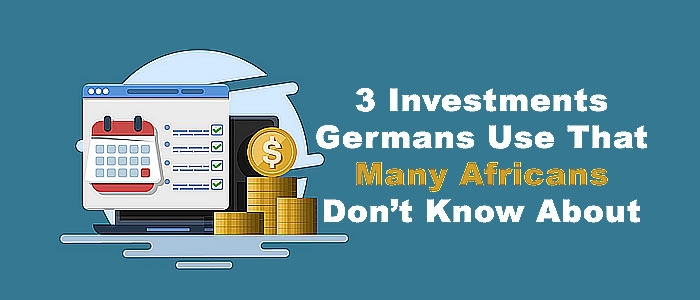
This guide explores three key Investments Germans Use that are less commonly adopted in many African markets:
- ETF Savings Plans (Sparplan investing)
- Employer and private pension investments
- Dividend and index fund investing
You will learn how they work, why they are popular in Germany, and how eligible foreigners can legally access them.
Expert Tip: Wealth in Germany is typically built slowly through consistency—not speculation. The earlier you start, the more you benefit from compounding.
Investment #1: ETF Savings Plans (Sparplan)
What is an ETF?
An Exchange-Traded Fund (ETF) is an investment fund that tracks a group of assets such as:
- Stock market indices (e.g., global markets)
- Sectors (technology, healthcare)
- Countries or regions
Instead of buying individual stocks, you invest in a diversified basket.
What is a Sparplan?
A Sparplan is a monthly automated investment plan where you invest a fixed amount (e.g., €25–€200+) into ETFs.
This is one of the most popular German investment strategies.
Why Germans love ETF investing
- Low fees compared to active funds
- Automatic monthly investing
- Long-term wealth building
- Strong diversification
- Emotional discipline (removes timing decisions)
Key Benefits
1. Compound Growth
Small monthly investments grow significantly over time due to reinvested returns.
2. Accessibility
Many brokers allow starting with low minimum amounts.
3. Diversification
Reduces risk by spreading investments across hundreds or thousands of companies.
Risks
- Market volatility
- No guaranteed returns
- Long-term commitment required
Example
If an investor contributes €100 monthly into an ETF Sparplan for 20 years, returns depend on market performance—but the principle is consistent, disciplined investing.
How foreigners can access ETF Sparplans
Foreigners in Germany can typically invest if they:
- Have a German bank account
- Complete identity verification
- Obtain a tax identification number
Popular regulated platforms include:
- Trade Republic
- Scalable Capital
- ING Germany
- Comdirect
ETF vs Savings Table
|
Feature |
ETF Sparplan |
Traditional Savings |
|
Growth potential |
Higher (market-based) |
Low |
|
Risk level |
Medium |
Low |
|
Accessibility |
High |
High |
|
Inflation protection |
Yes |
Limited |
Investment #2: Pension & Retirement Investments
One of the most important but overlooked German investment strategies is the structured pension system.
Germany offers two main types:
1. Occupational Pension (Betriebliche Altersvorsorge)
This is a workplace pension where employers contribute part of your salary into a retirement plan.
Key features:
- Employer contributions (in many cases)
- Tax advantages
- Long-term retirement savings
2. Private Pension Investments
These are voluntary retirement investment plans offered by financial institutions.
They may include:
- Fund-based pensions
- ETF pension plans
- Insurance-based retirement products
Why Germans use pensions heavily
- Strong retirement culture
- Tax incentives
- Employer participation
- Long-term financial security
Comparison Table
|
Feature |
Employer Pension |
Private Pension |
Personal Investing |
|
Tax benefit |
High |
Moderate |
None/standard |
|
Employer contribution |
Yes |
No |
No |
|
Flexibility |
Low |
Medium |
High |
|
Liquidity |
Low |
Low |
High |
Advantages for Foreigners
- Access available if employed in Germany
- Builds long-term retirement capital
- Encourages disciplined saving
Limitations
- Less flexibility
- Early withdrawal restrictions
- Dependent on employment status
Note: Combine pension investments with personal ETF investing for a balanced retirement strategy.
Investment #3: Dividend & Index Fund Investing
What is Dividend Investing?
Dividend investing involves buying shares of companies that regularly pay part of their profits to investors.
What is Index Fund Investing?
Index funds track entire markets (similar to ETFs) and provide broad exposure.
Why Germans prefer these investments
- Long-term stability
- Passive income generation
- Reduced emotional trading
- Strong focus on compounding
Key Benefits
1. Passive Income
Dividends can provide periodic cash flow.
2. Diversification
Index funds spread risk across many companies.
3. Long-Term Growth
Suitable for 10–30 year investment horizons.
Risks
- Market fluctuations
- Dividend cuts during downturns
- Currency and economic exposure
Example (Conceptual)
An investor holding diversified dividend-paying companies may receive periodic payouts while also benefiting from long-term share price growth.
Common sectors used in Germany
- Industrial manufacturing
- Healthcare
- Technology
- Energy
- Consumer goods
ETF vs Dividend vs Index Funds
|
Feature |
ETFs |
Dividend Investing |
Index Funds |
|
Income type |
Growth |
Passive income |
Growth |
|
Risk level |
Medium |
Medium |
Medium |
|
Complexity |
Low |
Medium |
Low |
|
Best for |
Beginners |
Income seekers |
Long-term investors |
Why These Investments Are Less Common in Many African Markets
The differences are not about ability or intelligence, but about systems, access, and financial environments.
Key factors include:
1. Financial Infrastructure
Germany has mature brokerage systems and regulated platforms.
2. Investment Accessibility
Low-cost ETF investing is widely promoted in Germany.
3. Financial Literacy Systems
Investment education is more embedded in formal financial culture.
4. Currency and Inflation Environment
Inflation pressures in some African economies can shift focus toward cash preservation.
5. Cultural Investment Preferences
Real estate and informal savings groups are more dominant in many regions.
Positive changes in Africa
- Rise of fintech apps
- Increased access to global markets
- Growing interest in ETFs and stocks
- Improved financial education
How Foreigners Can Start Investing in Germany
Step-by-step roadmap
- Open a German bank account
- Obtain a tax ID (Steuer-ID)
- Choose a regulated broker
- Complete identity verification
- Build an emergency fund
- Start with small monthly investments
- Diversify across assets
- Monitor annually
Required documents
- Passport
- Residence permit (if applicable)
- Tax ID
- Proof of address
- German bank account
Before You Invest Checklist
- Understand your risk tolerance
- Start with simple ETFs
- Avoid emotional trading
- Focus on long-term goals
- Use regulated platforms only
Note: Consistency beats timing. Monthly investing often outperforms trying to predict the market.
Frequently Asked Questions
Can international students invest in Germany?
Yes, if they meet broker and identity requirements.
Can Nigerians invest in German ETFs?
Yes, through regulated platforms where eligible.
How much do I need to start?
Some platforms allow small monthly investments.
Are ETF savings plans safe?
They are regulated but still subject to market risk.
Is investing better than saving?
Long-term investing generally offers higher growth potential.
Can foreigners receive dividends?
Yes, if they own dividend-paying assets.
Conclusion: Germany offers a structured and disciplined investment environment built around long-term planning, diversification, and financial stability. The Investments Germans Use ETF Sparplans, pension systems, and dividend/index investing—provide powerful tools for wealth building when used consistently over time.
For foreigners, these opportunities are accessible but require understanding of regulations, proper documentation, and a long-term mindset.
The key takeaway is simple: Wealth building is not about speed it is about consistency, discipline, and informed decisions.
Start small, stay consistent, invest legally through regulated platforms, and continue improving your financial knowledge over time




 How To Turn Income Into Assets
  10 Things You Should Stop Buying If You Want To Build Wealth
  Why One Income Stream Can Be Risky
  How To Develop Financial Discipline